
How Smart EDDM® Targeting Turned 5,000 Postcards Into High-Value Roofing Revenue
When severe storms moved through their service area, this roofing company knew two things:
- Homeowners would need help — fast.
- Whoever showed up first (and most professionally) would win the jobs.
Instead of running broad digital ads and hoping the right homeowners saw them, they launched a highly targeted Every Door Direct Mail (EDDM®) campaign focused specifically on storm-affected neighborhoods.
The result?
15 new roofing jobs from a single 5,000-piece mailing.
Let’s break down what happened — and how other roofing contractors can replicate these results.
The Campaign Snapshot
Industry: Roofing
Mail Volume: 5,000 postcards
Targeting: Storm-damaged neighborhoods
Offer Focus: Insurance claim assistance
Results:
- 15 new roofing jobs
- 0.3% conversion rate
- Tens of thousands of dollars in revenue from one drop
At first glance, 0.3% may not sound massive.
But in high-ticket home services like roofing, this is extremely strong performance.
If the average roofing job ranges from $8,000–$15,000+, those 15 jobs could easily represent:
- $120,000–$225,000+ in revenue
- From a single, small-volume mailing
That’s the power of relevance + timing.
Why EDDM Works So Well for Roofers
1. Roofing Is Hyper-Local
Roofing jobs are neighborhood-driven. When one home has storm damage, nearby homes likely do too.
EDDM allows roofers to:
- Target specific carrier routes
- Blanket impacted neighborhoods
- Saturate areas where damage is visible
Instead of guessing online, you go directly to the source.
2. Urgency Drives Action
Storm damage creates:
- Leaks
- Insurance deadlines
- Safety concerns
- Stress
This campaign leaned into urgency with messaging focused on:
- Immediate inspections
- Insurance claim assistance
- Fast turnaround
The postcard didn’t just advertise roofing.
It offered relief and guidance during a stressful moment.
3. Roofing Is High-Ticket (Low Response Still Wins Big)
With high average job values, roofers don’t need a 5% response rate to win.
Let’s put it in perspective:
- 5,000 postcards mailed
- 15 conversions
- 0.3% conversion rate
For industries like restaurants, 0.3% would be low.
For roofing?
It’s strong — because each job carries serious revenue.
Direct mail for roofers isn’t about mass responses.
It’s about precision wins.
What Made This Campaign Successful?
1. Smart Targeting
The company didn’t mail broadly across an entire ZIP code.
They focused on:
- Storm-affected routes
- Neighborhoods with visible roof damage
- Areas likely filing insurance claims
If you’re a roofer using EDDM, consider targeting:
- Older neighborhoods (roof lifespan 15–25 years)
- Higher home values (insurance coverage + ability to invest)
- Areas recently hit by hail or wind events
Timing matters more than volume.
2. The Right Offer: Insurance Assistance
Instead of “10% Off Roofing,” they led with:
“We’ll Help You Navigate Your Insurance Claim.”
That positioning:
- Reduced homeowner stress
- Built trust
- Removed friction
- Positioned them as experts, not salespeople
For roofers, strong EDDM offers include:
- Free storm damage inspections
- Insurance claim guidance
- Limited-time storm response specials
- Emergency tarp services
Make the offer about solving the problem — not just price.
3. Clear, Focused Postcard Design
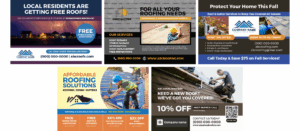
Effective roofing postcards typically include:
- Before/after roof imagery
- Bold “Storm Damage?” headline
- Trust indicators (licensed, insured, local)
- Simple call-to-action
- Phone number large and easy to read
- Optional QR code for fast scheduling
Avoid clutter.
When someone has roof damage, they don’t want to decode your design — they want clarity.
Like the designs above? Click here to customize one of our FREE EDDM templates for roofers.
Expanding on the Results: What 15 Jobs Really Means
Let’s break down the bigger picture.
Revenue Impact
If the average roofing project was:
- $10,000 per job → $150,000 total revenue
- $12,000 per job → $180,000 total revenue
From just 5,000 postcards.
Even after printing and postage, the ROI can be dramatic.
Long-Term Pipeline Impact
Those 15 jobs also lead to:
- Yard signs seen by neighbors
- Referral opportunities
- Repeat business
- Maintenance work
- Additional repairs uncovered during inspections
Storm-driven EDDM campaigns don’t just create revenue.
They create market presence.
How Roofers Can Replicate These Results
If you’re a roofing contractor, here’s a simple framework:
Step 1: Monitor Weather Events
Track storms in your service area. Timing is everything.
Step 2: Map Impacted Routes
Use a carrier route map to identify neighborhoods most likely affected.
Step 3: Build a Problem-Solving Offer
Lead with:
- Free inspection
- Insurance help
- Fast response
Step 4: Keep the Design Clean
- Strong headline
- One core message
- One main call to action
Step 5: Mail Fast
Speed matters. The closer to the storm event, the better.
Why EDDM Is a Strong Channel for Roofing in 2026
Digital ads are crowded — especially after storms. Every roofer floods Facebook and Google.
Direct mail cuts through that noise because:
- It reaches homeowners directly at their physical address.
- It feels credible and local.
- It isn’t competing in a scroll feed.
- It arrives at the exact home that needs the repair.
And when direct mail is timed properly?
It often converts before homeowners even start searching online.
Final Takeaway
This roofing company didn’t rely on luck.
They combined:
- Smart geographic targeting
- Urgent, relevant messaging
- A strong insurance-focused offer
- Clean, clear postcard design
- Perfect timing
And turned 5,000 postcards into 15 high-value roofing jobs.
In roofing, you don’t need massive response rates.
You need the right households, at the right time, with the right message.
And when you hit that combination, you can transform your season.
Learn more about EDDM for home services here.